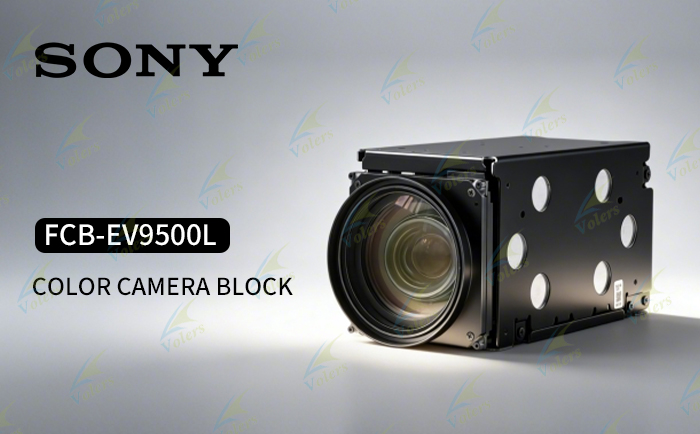
 Sony FCB camera block
A clear image at the moment the shutter is pressed depends on the continuous operation of the focusing system. Camera focusing technology has gone through a long evolution from manual focusing to fully automated intelligent tracking. Early cameras relied on manual focusing to ensure image sharpness. Later came a series of major technological leaps including contrast detection AF, phase detection AF, and laser AF. Today, cameras have entered the era of multi-dimensional AF systems empowered by AI algorithms, easily achieving millisecond-level precise focusing.
To understand focusing, let us first return to the basic principle of convex lens imaging. Everyone probably remembers the classic optics experiment from junior high school physics: light emitted by a lit candle passes through a convex lens and forms an inverted real image on a cardboard screen on the other side of the lens.
The distance from the candle to the center of the convex lens is called the object distance; the distance from the cardboard to the center of the convex lens is called the image distance; and the optical properties of the convex lens itself determine the focal length. The mathematical relationship among these three is the classic Gaussian imaging formula, which is also the underlying imaging principle of modern cameras. [1]
The essence of focusing is to drive the lenses inside the lens assembly to move and adjust the image distance so that the scene is clearly imaged on the image sensor. What we often call depth of field and depth of focus, explained from an optical perspective, means adjusting the lens position so that the imaging point of the target scene falls within the focal depth range of the focal plane.
I. Manual Focus: The Original Way of Focusing in Photography
Imagine a shooting scenario: turn the focus ring, keep your eyes fixed on the viewfinder, continuously make fine adjustments, and repeatedly compare image sharpness. With every small rotation of the focus ring, the brain continuously judges whether the image is becoming clearer. Once the best focus point is passed, you turn back in the opposite direction to find the sharp point again. Experienced photographers can achieve focus with just a few adjustments, while beginners often need multiple back-and-forth operations.
Early entry-level mobile phone cameras widely adopted fixed focus (FF), where the distance between the lens and the sensor is fixed. Relying on the characteristics of a small aperture and wide-angle lens, objects near and far are all kept within the depth of field. Today, most front-facing cameras on mobile phones still use fixed-focus solutions to meet selfie needs. However, the shortcomings are obvious: they cannot focus separately on objects at different distances, and close-up shots are prone to blur.
II. Contrast Detection AF (CDAF): The Starting Point of Autofocus
In 2003, the Panasonic P505iS became the first mobile phone to feature autofocus, bringing contrast detection AF into public view. The logic of contrast detection AF is highly similar to manual focusing, except that the judgment of sharpness is handed over to the camera processor: the higher the image contrast, the sharper the image. Many people have encountered a lens moving back and forth during focusing, commonly known as "focus hunting." This is exactly the process of the system continuously scanning to find the contrast peak.
The system first moves the lens in large steps for coarse positioning, and then makes small back-and-forth fine adjustments after approaching the peak. The principle is similar to using a microscope: first coarse focusing, then fine focusing.
Advantages: High final focusing accuracy.
Shortcoming: It requires continuous scanning to find the peak, so focusing is slow in low-light and low-texture, low-contrast scenes.
III. Phase Detection AF (PDAF): The Core Solution for High-Speed Focusing
In 2014, the iPhone 6 brought SLR-level phase detection autofocus to smartphones, completely changing the autofocus experience. Phase detection AF places dedicated phase detection pixels on the sensor, splits two beams of incident light, and directly measures the offset distance and direction of the light. In one step, it calculates the direction and distance the lens needs to move, without repeated trial and error.
The light reflected by the subject passes through the lens and is split into two beams, forming two imaging points on the sensor:
1. In-focus state: the two points coincide, and no lens adjustment is needed;
2. The sensor is in front of the convergence point: the distance the lens needs to move backward is calculated;
3. The sensor is behind the convergence point: the distance the lens needs to move forward is calculated.
SLRs rely on a mirror to split light and use a dedicated AF chip to achieve phase detection; mirrorless cameras and integrated camera modules generally use on-chip phase detection AF (OCPDAF), relying on pixel splitting (2PD) to collect phase signals.
Full-pixel dual-core CMOS AF is an upgraded form of phase detection AF. It uses two sets of photodiodes to separately collect image signals and directly guides lens movement based on the image offset, achieving "aim and focus." [2]
> Sony FCB camera modules use phase detection AF. Why can they achieve faster autofocus than other camera modules?
The answer lies in the underlying logic of phase detection AF: unlike contrast detection AF, which scans back and forth to find the sharpness peak, phase detection AF can directly calculate the movement direction and distance of the focus lens through phase difference, eliminating the trial-and-error process of repeatedly pushing and pulling the lens, known as "focus hunting."
At the same time, Sony FCB zoom camera modules rely on a mature phase detection AF architecture and proprietary AF drive algorithms to reach the in-focus position in one step, thus delivering outstanding autofocus speed.
At present, mainstream professional imaging devices generally adopt a hybrid solution of phase detection AF plus contrast detection AF: phase detection AF quickly moves the lens to the target range, and contrast detection AF completes micron-level fine calibration, balancing focusing speed and final image sharpness. Sony's hybrid AF system is a typical example.
Of course, phase detection AF is not omnipotent. In extremely poor lighting environments, focusing performance will degrade to some extent.
IV. Laser AF: A Powerful Assistive Tool for Focusing in Low Light
Laser AF is an active focusing technology: the device emits an invisible infrared laser to illuminate the target object, receives the reflected laser, and uses time of flight to precisely measure the shooting distance, transmitting the distance data to the focus motor.
It is not constrained by image contrast. In dark night environments, on solid-color walls, or on objects lacking texture, it can measure distance stably, making up for the shortcomings of phase detection and contrast detection AF in low-contrast scenes.
Limitations: In bright outdoor environments, natural infrared light can easily cause signal interference; at the same time, laser emission and reception increase power consumption, so it is generally used as an auxiliary focusing method. The LG G3 was the first mobile phone to feature a laser focusing solution, and the Honor Magic6 LiDAR array focusing system is also an extended application of this technology.

Multi-dimensional Fusion + AI: Modern AF Systems Evolve Comprehensively
Today's flagship cameras, industrial camera modules, and smartphones no longer rely on a single focusing technology. They generally integrate phase detection AF, contrast detection AF, and laser AF into composite AF systems. At the same time, with the support of high-performance imaging chips, AI is deeply involved in the focusing process: real-time recognition of faces, eyes, animals, and high-speed moving targets enables continuous intelligent tracking. Whether for action snapshots or long-duration video recording, the focus can be stably locked and the image kept clear.
From the film era of manually turning the focus ring to the intelligent imaging era of AI multi-dimensional tracking, focusing technology continues to iterate. For integrated camera modules widely used in drone inspection, industrial inspection, remote monitoring, and vehicle imaging, focusing speed and tracking stability directly determine the quality of captured images. Represented by Sony FCB camera modules, the high-speed focusing capability built on phase detection AF technology is precisely a key reason why many industry projects choose them.
FAQ
Q: What is the difference between camera focusing and zooming?
A: Focus: Adjusts the distance between the lens group and the sensor. Goal: make the image clear.
Zoom: Changes the internal optical structure of the lens. Goal: adjust the field of view and magnify or reduce the subject.
Author
Danny Wong, Co-founder & Chief Technology Officer of Ruilong Electronic, compiled in September 2026.
Shenzhen Ruilong Electronic Information Technology Co.,Ltd., an officially authorized distributor of Sony (China), has 17 years of experience in HD video secondary development and implementation. It has independently developed IP / SDI / HDMI / USB / MIPI multi-type interface encoding control boards, and also provides a DSLR camera network control board compatible with the ILX-LR1. It can provide pre-sales solution consulting, on-site debugging, and after-sales technical support, support connection with Sony's original factory technical resources, and solve project problems on site.ap