 Sony FCB camera block
Wastewater monitoring is not an ordinary security scenario. It requires clear visibility of motion, accurate color identification, retainable evidence, and platform integration. If you simply use a conventional bullet/dome camera configuration, it is easy to fail at critical moments such as illegal discharge through hidden pipes, turbidity on rainy days, occlusion by floating debris, and low illumination at night.
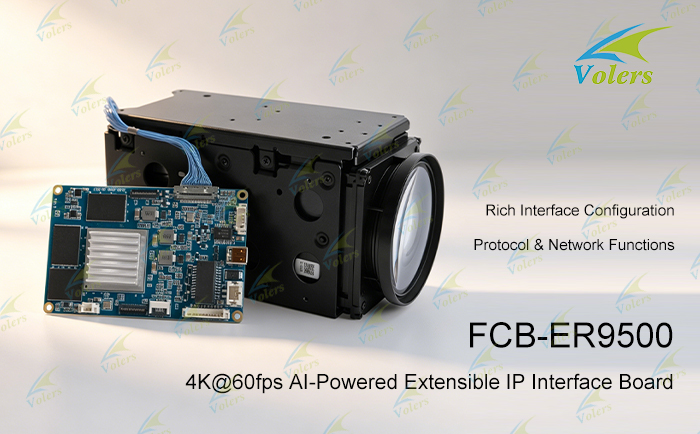
As an official authorized distributors of Sony (China) and an HD video secondary development solution provider, Ruiloog Electronic offers the Sony FCB-ER9500 integrated camera module + 4K@60fps AI-Powered Extensible IP Interface Board. This is a “video capture + transmission + control” combination for off-site supervision by water authorities, focusing on solving four things: high-speed water flow without blur, dynamic interference without focus loss, water quality color differences without distortion, and video logs that can be networked and retained.
I. What Exactly Makes Wastewater Monitoring Difficult?
Video evidence collection at sewage outfalls and hidden pipes discharging into rivers follows a completely different logic from campus security or road checkpoints:
1. Pollution sources spread quickly: Illegal discharge from hidden pipes can surge out instantly. At 30 fps, water flow edges easily smear, making it difficult to pin down pollutant boundaries and the exact start and end times of discharge.
2. Many interfering objects: Floating garbage, aquatic plants, branches, inspection boats, and raindrops can enter the frame at any time. If an ordinary integrated camera module loses focus due to autofocus, the critical 2 seconds may be missed.
3. Color is evidence: Pale yellow domestic sewage, yellowish-brown natural river water, light green heavy-metal-containing wastewater, and pale red dye wastewater—even a slight color shift can lead to misjudgment by both AI classification and manual review.
4. It must be networked and traceable: For wastewater monitoring, coverage of key points, tamper-proofing, video loss/occlusion/network disconnection alarms, GB28181 networking, and log retention for at least 1 year are all hard requirements.
5. Unstable networks in the field: Full 4K backhaul consumes too much bandwidth. The edge side must be able to cache locally, backfill after network recovery, and push only alarm clips.
Therefore, the selection order should be: dynamic sampling capability → focus stability → color fidelity → encoding and networking → AI scalability, rather than first comparing who has more pixels.
II. Why FCB-ER9500 + 4K@60fps AI-Powered Extensible IP Interface Board
1. How does 4K/60p ensure smooth images?
There is a basic logic in high-speed imaging: the more intense the motion, the higher the priority of frame rate; for large-field detail recognition, the higher the priority of resolution.
Wastewater discharge requires both—you need a large field of view to see the whole outfall (supported by 4K resolution), and 60 fps to separate turbulent boundaries and floating object trajectories frame by frame.
The FCB-ER9500 outputs a 4K signal, which is captured at 4K60p and H.264/H.265 encoded by the 4K@60fps AI-Powered Extensible IP Interface Board. Later, it can be used to identify discharge start/end times and estimate diffusion rates, making the evidence chain stronger.

2. Fast autofocus: not just “focusing fast,” but “not being led astray by interference”
There is always something moving on the wastewater surface. The FCB-ER9500 uses contrast autofocus technology + proprietary high-speed AF search + area autofocus (the AF frame can be locked on the outfall plane) + stepper motor zoom. When dynamic objects cross the foreground, the focus does not follow the floating debris but stays locked on the target.
3. Color reproduction: broadcast-grade wide color gamut, leaving clean input for AI
The FCB-ER9500 supports RGB 4:4:4 / YPbPr 4:2:2 output. Chroma signal-to-noise ratio and gamma consistency are tuned to broadcast component standards, so subtle water color differences are not flattened by algorithms.
For backend visual AI, the more linear the input color, the lower the false alarm rate of classification models; for manual review, screen-recorded frame grabs can directly serve as chroma comparison reference images.
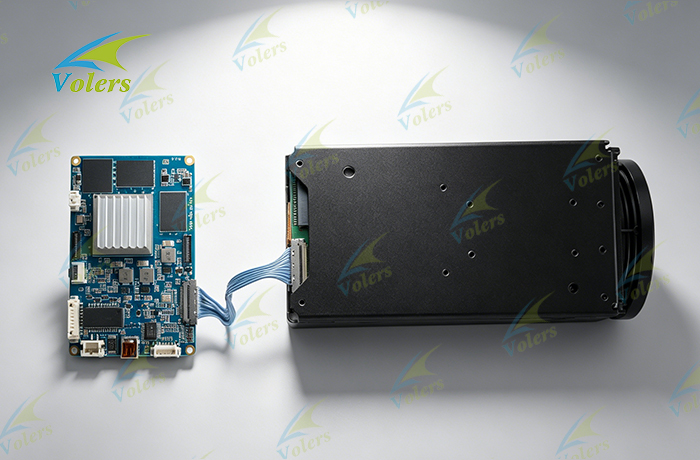
4. 4K@60fps AI-Powered Extensible IP Interface Board: turning the “camera module” into a “networkable node”
A standalone camera module is only a sensor + ISP and cannot connect to a smart water platform. This board adds:
4K HDMI local monitoring + network RTSP/ONVIF dual outputs, so the large screen and cloud platform do not compete for bandwidth;
VISCA / Pelco D/P PTZ zoom control, ONVIF / GB28181 access to NVR and ecological environment video cloud;
Onboard basic AI computing power (area intrusion, occlusion detection, video loss), with optional face/vehicle/license plate recognition. After authorization, users can flexibly integrate self-developed AI algorithms to quickly expand customized functions such as intelligent analysis and intelligent tracking.
III. Scenario Matching: Which Sites Is This Combination Suitable For?
Site Type | Main Pain Points | How This Solution Addresses Them |
|---|---|---|
River outfall / hidden pipe outlet | Instantaneous discharge, blurred boundaries | 4K60 frame-by-frame, area AF locked on outfall |
Industrial wastewater open channel | Color difference identification, dye/heavy metal distinction | 4:4:4 wide color gamut, low color shift |
Stormwater outfall illegal discharge on dry days | Floating debris interference, unattended operation | Area intrusion AI + occlusion alarm |
Monitoring station sampling point | Tamper-proofing, full-process traceability | GB28181 networking, logs not deleted or altered |
River inspection boat-mounted | Shaking + water light reflection | Fast AF + high frame rate to suppress jelly effect |
IV. Summary
When choosing a visible-light camera for wastewater monitoring, the pixel count does not necessarily need to be the highest. Choose one with 60 fps that does not lose boundaries, area autofocus that does not lose focus, and RGB 4:4:4 without color shift.
The Sony FCB-ER9500 + 4K@60fps AI-Powered Extensible IP Interface Board essentially brings the color and dynamic capabilities of a broadcast-grade camera module down to water edge nodes—no frame loss in dynamic discharge, no distortion of subtle color differences, and no loss of evidence even when the network drops.
FAQ
Q: Why is the FCB-ER9500 more suitable for outfalls than an ordinary 4K bullet camera?
A: Ordinary bullet cameras are mostly 30 fps, have consumer-leaning ISP color tones, and AF tracks the foreground. The Sony FCB-ER9500 is an 8MP visible-light camera module with 60 fps output + area autofocus + RGB 4:4:4 color-shift-free output, specifically adapted for evidence collection scenarios involving motion and color differences.
Q: Is the built-in AI on the 4K@60fps AI-Powered Extensible IP Interface Board sufficient?
A: It is sufficient as a baseline—occlusion, video loss, and area intrusion are standard features. To perform “light green/light red wastewater classification,” a self-developed color gamut model needs to be loaded after authorization. The board reserves an expansion port for direct connection.