 Sony FCB camera block
Ports are core hubs for water-land intermodal transport, but their operating environments are far harsher than typical outdoor scenarios: sea surface reflections overlap with day-night brightness contrast, heavy fog and rain compress visible distance, gantry cranes and ships vibrate continuously, containers and vessels move fast, and the port area has great depth with many long-distance blind spots—surveillance must not only "see clearly" but also "see steadily."
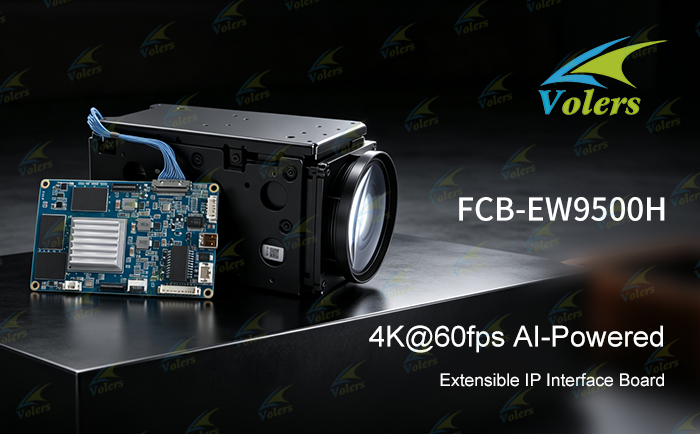
In response to these conditions, Ruiloog Electronic[1], a Sony (China) officially authorized dealer, recommends the "Sony FCB-EW9500H + 4K@60fps AI-Powered Extensible IP Interface Board" video solution, which uses 4K/60fps high-resolution, high-frame-rate imaging and networked long-distance transmission to cover surveillance scenarios across the entire port area.
I. The Surveillance Dilemma of Existing Ports Is Essentially an Optical Problem, Not a Pixel Problem
The list of port surveillance pain points is long: strong sea surface reflections, wide day-night illumination range, backlight from dock lights, vibration from gantry cranes and ships, fast-moving container trucks, and low-light evidence collection at night. These pain points are often categorized as "image quality" issues and addressed with higher pixels, larger sensors, or stronger back-end AI. But when broken down, most of them cannot be solved at the pixel level.
Specular reflection and backlight from the sea surface cause local overexposure. No matter how high the pixel count, the signal in the overexposed area is already saturated and the information cannot be recovered. The failure of nighttime evidence collection for ship hull markings and cargo features is rooted in an insufficient number of photons reaching the sensor, not in insufficient resolution. Motion blur caused by equipment vibration is a time-dimension problem and has nothing to do with spatial resolution. Under foggy conditions, visible light is scattered and attenuated by aerosol particles; increasing pixel density only makes noise and blur more finely magnified.
In other words, the core contradiction in existing port surveillance is not "resolution is not high enough," but that the optical entrance loses too much original signal under extreme lighting and medium conditions. No matter how powerful the back-end AI is, it cannot recover information that physically does not exist from a saturated or underexposed frame. This judgment is the starting point for understanding the value of the Sony FCB-EW9500H solution.
II. What Are the Irreplaceable Advantages of the FCB-EW9500H?
The competitiveness of the Sony FCB-EW9500H in port scenarios should be understood from the very front end of the signal chain, rather than remaining at the level of a parameter list.
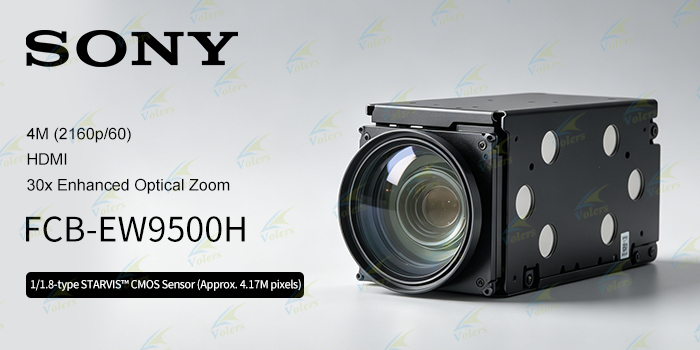
30x enhanced optical zoom addresses coverage efficiency.
The 6.5–162.5mm zoom range allows a single camera to switch seamlessly between panoramic situational awareness and long-distance detail: the wide-angle end covers the large-scale situation of berths and yards, while the telephoto end directly captures container numbers, ship hull numbers, or key structural details of quay cranes. For existing terminal renovation, the engineering significance of this capability far exceeds the parameter itself—reducing camera point deployment means reducing the construction workload for poles, power supply, and transmission, which are precisely the highest-cost and highest-resistance links in existing scenarios.
The 1/1.8-inch STARVIS CMOS and 0.00008lx color night vision address the "information dimensionality reduction" problem in nighttime port evidence collection.
Traditional surveillance degrades to black-and-white imaging under low illumination, and all color information—ship hull paint, cargo labels, and personnel workwear—is lost, greatly reducing the value of later review. The FCB-EW9500H's ICR ON COLOR solution maintains color output under low-light conditions, allowing nighttime images to retain color-dimensional discriminating clues.
Combined with RGB 4:4:4 color sampling, color information is not subjected to secondary compression before encoding. For evidence-collection scenarios where "color is evidence"—for example, distinguishing container paint schemes of different shipping companies or identifying color blocks of dangerous goods labels—this is something grayscale imaging cannot replace.
Defog needs to be understood at the level of physical principles, including its boundaries.
Near-infrared light has a longer wavelength than visible light, is less affected by scattering from atmospheric aerosol particles, and can penetrate a certain concentration of haze. The FCB-EW9500H's low/medium/high three-level defog is essentially an algorithmic use of this physical window, fusing or weighting near-infrared components that penetrate haze with visible-light information.
This means that under common port conditions such as sea fog, rain, and dawn/dusk thin fog, the outlines of long-distance targets can be preserved. But defog is not a wall-penetrating trick: under dense fog, near-infrared light is also attenuated. The value of the solution lies in extending the lower limit of usable visibility, not in claiming all-weather unconditional clarity.
Super image stabilization addresses the large number of non-ideal installation conditions in existing ports. The vibration amplitude and frequency of gantry cranes, ship masts, vehicle-mounted gimbals, and temporary poles are much higher than those of fixed security brackets. The combination of optical stabilization and algorithmic stabilization here is not "icing on the cake," but rather turns these positions into usable installation points.
III. 4K@60fps AI-Powered Extensible IP Interface Board: The Video Implementation Solution
The optical capabilities of the FCB-EW9500H require a complete back-end link to be implemented. Ruiloog Electronic's 4K@60fps AI-Powered Extensible IP Interface Board in this combination is not simply an "interface converter," but an edge-side intelligence and transmission hub.
From the causal relationship between frame rate and AI, the significance of 2160P@60fps goes beyond smooth images. The input quality of AI object detection and tracking models directly depends on the displacement of targets between frames: at 30fps, a fast-moving container truck may displace too much between adjacent frames, and detection box association may easily break; 60fps halves the inter-frame displacement, significantly improving tracking continuity and reducing missed detections and ID switches. This is the often-underestimated value of high frame rate in intelligent surveillance—it first serves algorithm stability, and only secondarily the human viewing experience.
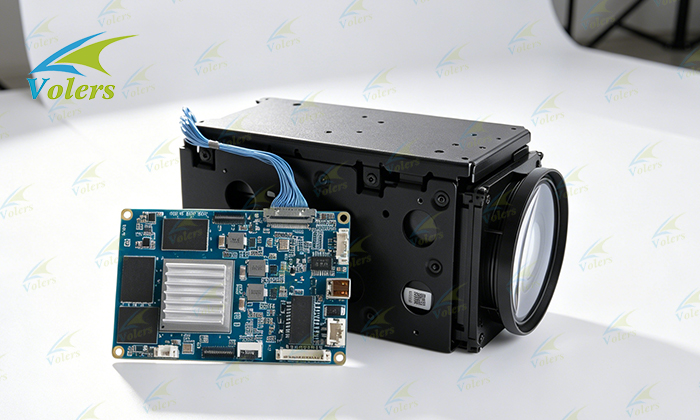
The basic AI computing power built into the 4K@60fps AI-Powered Extensible IP Interface Board (capable of recognizing more than 80 categories of objects) gives port perimeter security and restricted-area control front-end closed-loop capability. Area intrusion, line-crossing detection, and loitering warnings can be judged directly at the camera end and output as alarms, without transmitting the full-frame-rate 4K video stream back to a back-end server for analysis. Under the reality that existing port network bandwidth is often limited, the value of front-end filtering is not "technological advancement," but making intelligent analysis feasible under existing network conditions.
ONVIF/RTSP protocol compatibility determines the friction coefficient of solution implementation. Existing ports generally have already deployed NVRs, security management platforms, or large-screen command systems. If newly connected visual devices require deep adaptation or protocol conversion on the platform side, the renovation cycle and hidden costs will quickly erode the price advantage of the solution. Standard protocol direct connection means this combination can be integrated without touching the existing platform architecture, which is a rigid requirement for existing scenarios where production and renovation proceed simultaneously.
FAQ
Q: The Sony FCB-9500 series has three models with the same appearance dimensions. Why is the FCB-EW9500H more suitable for port surveillance?
A: The core differences among the three models are not in appearance, but in output capability and interface. The FCB-EV9500M provides Full HD MIPI output, and the FCB-EV9500L provides Full HD LVDS output; both have an effective pixel count of 2 million. The FCB-EW9500H provides 4-megapixel 2160P@60fps HDMI output. In port scenarios, the practical benefit is not that the pixel number is larger, but that more usable detail is retained during long-distance zoom capture, and that inter-frame displacement of high-speed targets is reduced when working with AI tracking at 60fps. If the port application requires 4K resolution and direct HDMI output, the FCB-EW9500H is the better choice among the three.
Q: The FCB-EW9500H outputs 4 megapixels. Is it an HD or a 4K integrated camera module?
A: This is a question easily confused by industry terminology. Full HD (HD) corresponds to approximately 2 million pixels (1920×1080), and 4K UHD corresponds to approximately 8.3 million pixels (3840×2160). 4 megapixels (approximately 2688×1520) falls between the two; it can neither be strictly classified as HD nor does it meet the pixel threshold of 4K UHD. A more accurate term is 4M integrated camera module or 4-megapixel integrated camera module.