 Sony FCB camera block
In industrial vision, medical imaging, drone, and robot guidance projects, the interface type of the camera module directly determines whether the entire system can run stably. Many engineers only look at resolution and frame rate parameters during selection, ignoring the underlying differences among USB, IP network, and LVDS interfaces. This ultimately leads to troublesome issues such as excessive latency, screen tearing in workshops with electromagnetic interference, frame drops over long distances, and inaccurate high-speed positioning.
The mainstream camera module interfaces on the market fall into three categories: USB, network IP, and LVDS. Their paper specifications may look similar, but they differ greatly in transmission latency, interference resistance, bandwidth upper limit, and effective transmission distance. Especially in high-speed dynamic imaging and high-precision alignment scenarios, LVDS differential transmission solutions have become the first choice for many high-end projects due to their low latency, high bandwidth, and strong interference resistance.
I. Different Underlying Transmission Principles, Different Inherent Advantages and Disadvantages
Different interfaces rely on different transmission protocols, which fundamentally define their applicable boundaries. This is also the first thing to understand during selection.
1. USB Camera Modules
USB cameras use YUV general data stream output.
The highlight is plug-and-play: no additional encoding/decoding board is required, and they can connect directly to industrial PCs and embedded motherboards. The entry barrier is low, and development speed is fast.
The shortcomings are equally prominent: short transmission distance. USB 3.0 generally supports stable transmission only within 5 meters; extending the distance requires adding repeaters. In complex electromagnetic environments such as industrial sites with motors and frequency converters, packet loss and momentary disconnections are likely. At the same time, the USB bus is shared bandwidth. When other peripherals on the motherboard occupy resources, high-resolution and high-frame-rate images are prone to stuttering and frame drops.
2. Network Camera Modules (IP Cameras)
They transmit based on Ethernet protocols, commonly known as network camera modules.
Their advantages are long-distance transmission and networking capability. A single network cable segment can stably transmit over 100 meters, and they support direct access to existing LANs, centralized management and unified preview of multiple cameras, making them very suitable for multi-point distributed deployment.
Their pain point is latency: images need to go through the entire process of encoding, packetization, network transmission, and backend decoding. Conventional network modules generally have latency of 30–100 ms. If shielding and industrial network isolation are not properly implemented, in strong electromagnetic environments they are prone to image mosaics and data packet loss, making it difficult to meet closed-loop real-time control requirements.
3. LVDS Camera Modules
LVDS stands for Low-Voltage Differential Signaling, a transmission solution designed specifically for high-speed industrial scenarios. It relies on differential signals to cancel external interference, giving it extremely strong signal interference resistance. With direct underlying transmission, there is almost no additional latency caused by protocol encoding and decoding. In the commonly used range of 0.05–2 meters, no signal amplification is needed, and images are transmitted losslessly.
Most Sony HD integrated camera modules (except FCB-EV9500M) output LVDS signals, with native high bandwidth and low latency, suitable for various devices with strict real-time requirements.
II. Horizontal Comparison of Core Performance to Quickly Match Project Requirements
Comparison Dimension | USB Camera Module | Network Camera Module | LVDS Camera Module |
|---|---|---|---|
Transmission bandwidth | USB3.0: 5Gbps | 100M: 100Mbps | Single channel: 1.923Gbps |
Theoretical maximum transmission distance | 5 meters (up to 20 meters with repeater extension) | Over 100 meters | Stable ≤3 meters in high-frame-rate scenarios |
Electromagnetic interference resistance | Relatively weak, susceptible to interference from workshop power equipment | Medium, depends on shielded cables and industrial switches | Extremely strong, suitable for high-interference industrial sites |
Development and deployment difficulty | Extremely low, plug-and-play | Medium, requires IP configuration and network debugging | Medium, must be paired with a matching decoder board |
Ⅲ. Scenario-Based Selection: There Is No Universal Interface, Only a More Suitable Solution
There is no universal interface. The key depends on the project’s distance, real-time requirements, electromagnetic environment, and networking needs.
1. USB Camera Modules: Short-Distance, Rapid Development, Low-Cost Scenarios
Suitable for desktop 3C inspection stations, small teaching and experimental equipment, and simple visual inspection fixtures. With short wiring and little surrounding interference, and when rapid verification and reduced development costs are valued, USB camera modules have obvious cost-performance advantages. No complex debugging is needed; images appear as soon as they are plugged in, making them suitable for rapid prototype verification.
2. Network Camera Modules: Long-Distance, Multi-Device Centralized Networking Scenarios
Large-area factory security, river and water utility monitoring, and multi-point remote inspection are the main battlegrounds for network-port modules. Relying on existing LAN wiring, multiple cameras can be centrally connected to a platform, and long-distance transmission requires no complex adapters. They are suitable for projects that do not require millisecond-level closed-loop control and mainly focus on video playback and remote monitoring.
3. LVDS Camera Modules: Low-Latency, High-Speed Closed-Loop, High-Interference Scenarios
High-speed assembly line visual positioning, robot visual guidance, drone aerial photography, vehicle-mounted vision, medical endoscopy and intraoperative imaging, and precision machine tool alignment—these closed-loop control scenarios are extremely sensitive to latency. Once latency is too high, it will cause positioning offset and tracking failure. The low latency and strong interference resistance of LVDS make it the choice for such scenarios.
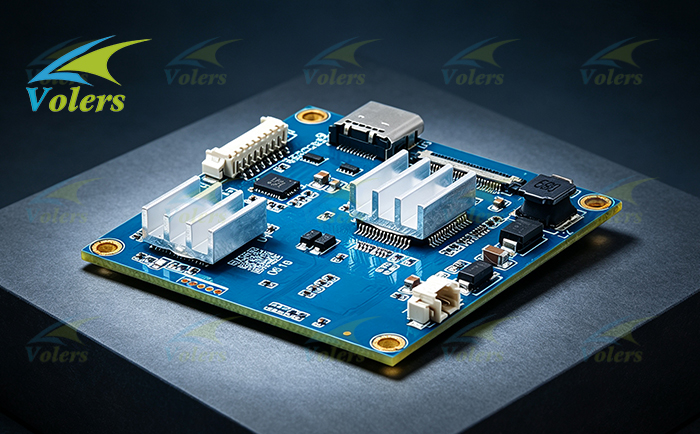
What if you choose a Sony zoom camera module but the project only supports USB or network ports? To address this pain point, Xuanzhan Technology, as an officially authorized dealer of Sony (China), provides self-developed video solutions: USB3.0 video capture boards, USB Type-C video capture boards, and LVDS or MIPI to IP network interface boards, which flexibly convert LVDS signals to USB or network output. Without modifying the camera itself, they can adapt to industrial PCs and embedded platforms, enabling implementation in industrial inspection, medical, drone, special security, and other scenarios, greatly reducing the difficulty of secondary development and shortening project cycles.
FAQ
Q: Are LVDS camera modules always better than network camera modules?
A: No. The advantages of LVDS cameras are real-time performance and interference resistance, making them suitable for dynamic closed-loop control. However, their transmission distance is limited, and they are not convenient for long-distance networking. For remote multi-point monitoring and long-distance inspection, network camera modules are actually more suitable.
Q: Are all Sony FCB modules LVDS interfaces?
A: Most Sony FCB auto-zoom modules output LVDS. FCB-EV9500M is an exception. During selection, you need to confirm the interface specifications in advance and then pair them with the corresponding adapter board.