 Sony FCB camera block
There is an often-underestimated cost in drone gimbal design: endurance that is directly deducted from the battery budget. A concise conclusion in Introduction to Unmanned Aircraft Systems is that, when maximum takeoff weight is fixed, endurance is approximately linearly related to battery weight. Every additional gram of payload means one gram less battery, and endurance decreases proportionally. Take a quadrotor with an empty weight plus battery of 3 kg as an example: adding 0.4 kg of payload reduces endurance by about 17%.
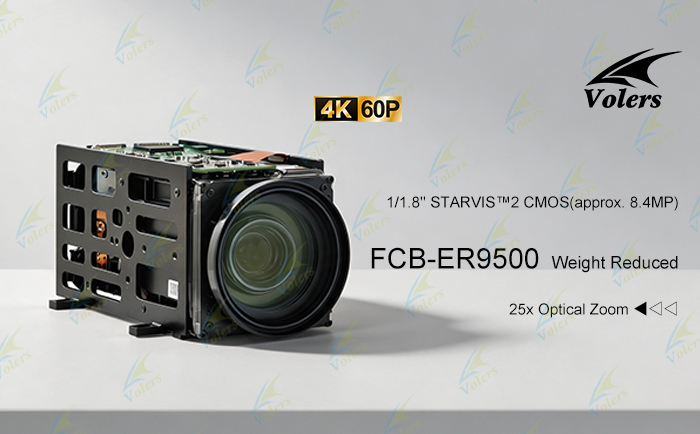
The FCB-ER9500 Weight Reduced Version launched by Our Company starts precisely from this payload economics logic: it reduces the weight of the original Sony FCB-ER9500 from about 464 g to about 310 g, a reduction of about 154 g, while fully retaining all imaging configurations of the original version. What it aims to answer is how to return the saved weight budget to endurance, payload margin, and gimbal stability without cutting imaging capability.
I. Where Does the Weight Reduction Come From, and Why Has Imaging Not Been Reduced Along with It?
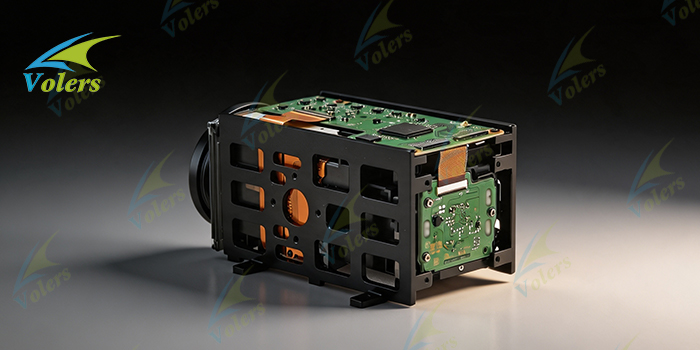
The weight-reduction path of the FCB-ER9500 Weight Reduced Version is replacement of the outer shell at the structural level, not removal of any link in the core imaging chain. Our Company redesigned the original metal shell into an aluminum alloy shell, while the internal optical module, sensor, image processing circuit, and motor drive structure fully follow Sony's original design. Therefore, the 1/1.8-inch STARVIS 2 CMOS, 4K/60p output, 25x optical zoom, wide dynamic range, infrared-sensitive color mode, image stabilization, and spot auto focus/exposure/white balance all remain unchanged.
A question worth asking is: if the shell is changed to aluminum alloy and weight is reduced, will heat dissipation be sacrificed? On the contrary. Aluminum is a preferred material in lightweight design: its density is low, but its thermal conductivity is better.
II. After the 154 Grams Are Saved, Where Do They Go?
Only by putting the weight reduction back at the system level can its actual destination be seen clearly.
The first account: returned to endurance.
The payload–endurance relationship mentioned in the introduction has already explained that, on platforms with limited takeoff weight, every gram of payload weight is equivalent to a reduction in battery weight. A 154-gram reduction means the battery budget can have 154 grams more, or that hovering power demand can be reduced under the same battery configuration. For solar-powered long-duration unattended equipment and low-power field monitoring nodes, the significance of these 154 grams is equally concrete: lower payload power demand directly extends the time window for energy-neutral operation. Under the large-scale development of the low-altitude economy, industrial drones' requirements for lightweight design and endurance are continuously increasing, and miniaturization of payload integration has become a clear direction in the evolution of visible-light modules.
The second account: returned to payload configuration flexibility.
A 154-gram reduction does not mean that this weight can only be "saved." In gimbal design, the margin can be allocated to a second sensor, a larger battery, or a lightweight video transmission module. For small drone gimbals, intelligent gimbals, lightweight vehicle-mounted terminals, and portable medical teaching equipment, the size and weight of the Weight Reduced Version fall within a range that allows embedding without modifying the original structure. What is lowered is the integration threshold for complete equipment manufacturers, not just the nominal figure of the module itself.
The third account: returned to gimbal dynamics.
The weight of the gimbal payload directly affects moment of inertia and motor load. The heavier the payload, the more difficult it is for the gimbal to maintain line-of-sight stability during high-speed movement, bumping, and multi-angle rotation, and the higher the probability of image smearing and offset. Lightweight design itself is one of the basic evolutionary directions of gimbal design. Research on single-light-payload gimbals for multirotor drones lists lightweight design and miniaturization as core paths for improving stability performance. The 154 grams reduced by the FCB-ER9500 Weight Reduced Version, combined with the module's own Super+ image stabilization and dynamic compensation algorithms, translates at the gimbal level into lower inertial burden and more predictable stability performance.
Ⅲ. ightweight Design Does Not Mean Interface Compromise: Full-Link Output Capability Retained As-Is
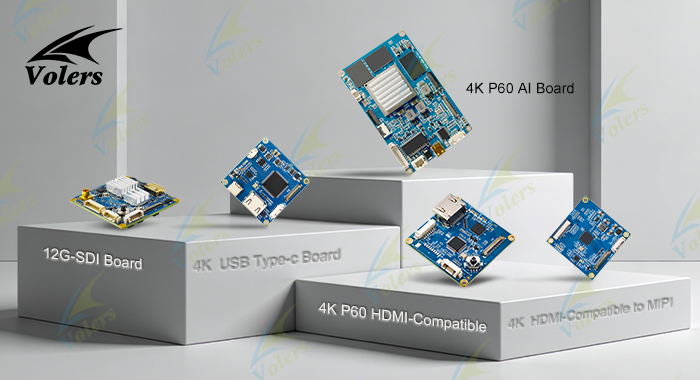
In system integration, the FCB-ER9500 Weight Reduced Version continues to use all encoder control board solutions of the original Sony FCB-ER9500, and does not require re-customization of output hardware for lightweight projects:
Output Interface | Interface Board | Compatible Modules |
|---|---|---|
SDI output | 12G-SDI interface board | FCB-ER9500 / FCB-ER9500 Weight Reduced Version |
Network output | 4KP60 AI network interface board | Same as above |
HDMI output | 4KP60 HDMI interface board / 4K HDMI interface board | Same as above |
USB output | 4K USB Type-C viseo capture module | Same as above |
MIPI output | 4K HDMI to MIPI interface board | Same as above |
This means the Weight Reduced Version does not create a trade-off between "lightness" and "interface completeness." Broadcast-grade long-distance SDI transmission, IP stream distribution, HDMI direct monitoring, USB debugging capture, and MIPI connection to embedded SoCs—all five output paths are completely identical to the original Sony version. For teams that have already established hardware solutions around the FCB-ER9500, switching to the FCB-ER9500 Weight Reduced Version does not trigger any re-selection at the encoder control board level.
A Boundary That Needs to Be Clarified: It Reduces Weight, Not Volume
The engineering constraint of the FCB-ER9500 Weight Reduced Version is worth clarifying before selection: to ensure that imaging performance is completely consistent with the original version, the Weight Reduced Version retains the original internal hardware architecture, so the body dimensions are not reduced accordingly. The priority problem it solves is the squeeze that weight places on endurance, payload margin, and gimbal burden, not providing a smaller camera module for extremely confined spaces. If the primary constraint of a project is volume rather than weight, other miniaturized module solutions should be considered.
Summary
When a project needs a lightweight integrated camera module but still requires 4K/60p, 25x zoom, and complete imaging control capability, the FCB-ER9500 Weight Reduced Version provides a weight-release path without quality reduction. It does not attempt to trade parameter compromises for lightness; instead, it saves weight from the shell structure and returns it to the battery, gimbal, and mission payload. For teams planning small drone gimbals, portable vision terminals, or low-power long-duration unattended equipment, these 154 grams are worth recalculating once in the payload budget table.
FAQ
Q: Is the imaging performance of the FCB-ER9500 Weight Reduced Version truly completely identical to the original version?
A: Yes. The FCB-ER9500 Weight Reduced Version only changes the body shell structure and material. The internal optical module, sensor, image processing circuit, and motor drive system fully follow the Sony FCB-ER9500 design. Functions such as 4K/60p, 25x optical zoom, STARVIS 2 CMOS, wide dynamic range, image stabilization, and auto focus/exposure/white balance are all unchanged.
Q: Are the body dimensions of the FCB-ER9500 Weight Reduced Version reduced accordingly?
A: No. To ensure that imaging performance is completely consistent with the original Sony FCB-ER9500, the FCB-ER9500 Weight Reduced Version strictly retains the original internal hardware architecture during secondary development, and the body dimensions cannot be further compressed. The Weight Reduced Version prioritizes solving the weight problem. If a project has strict volume constraints, other miniaturized camera modules should be evaluated.