 Sony FCB camera block
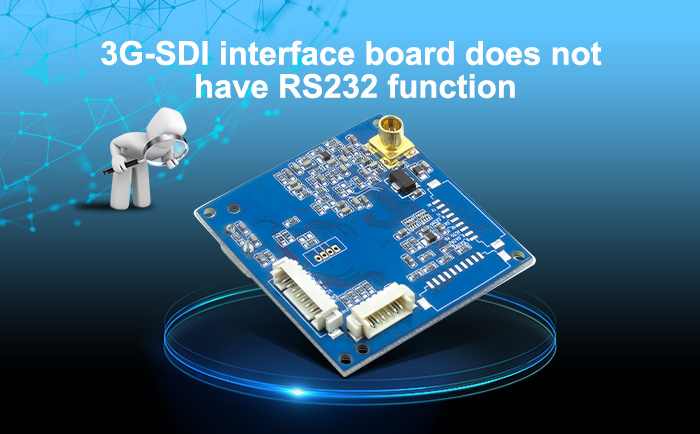 However, whether it is the user who is using 3G-SDI interface board, or the target customer who is planning to use it, in their minds, there is a common question: why does 3G-SDI interface board have no RS232 function?
Today, Danny Wong, senior engineer of Xuanzhan Technology, will personally analyze and answer your questions.
However, whether it is the user who is using 3G-SDI interface board, or the target customer who is planning to use it, in their minds, there is a common question: why does 3G-SDI interface board have no RS232 function?
Today, Danny Wong, senior engineer of Xuanzhan Technology, will personally analyze and answer your questions.
Differences between TTL, RS232 and RS485
RS232 and RS485 are three different serial communication standards, they are different in the definition of nature, communication distance and rate, communication mode and compatibility.
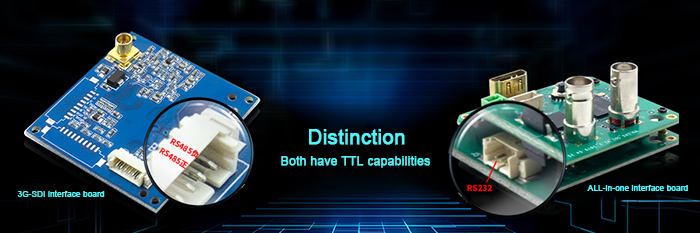
01 Definition and property
TTL (Transistor-Transistor Logic) : TTL is a digital signal level standard. RS232: RS232 is a single point communication protocol that uses a pair of transmission lines (TX, RX) for two-way communication. RS485: RS485 is a serial communication interface standard, it uses differential signal transmission, suitable for long-distance communication, with high speed, long distance, strong reliability, strong anti-interference ability and other characteristics. 02 Communication distance and speed TTL: Suitable for short-distance communication, the communication distance is generally not more than 50 cm, usually used for data communication between cpus, microcontrollers, digital signal processing, digital circuits and other devices. RS232: also suitable for short-distance communication, the communication distance is generally not more than 15 meters, the communication rate can reach 115.2kbps, often used in personal computers, PLC and industrial control equipment and other occasions, but in practical applications may be limited by signal attenuation and noise interference. RS485: Suitable for long-distance communication, the maximum communication distance of up to 1200 meters (under ideal conditions), and support high-speed data transmission, the highest transmission rate of up to 10Mbps (but the transmission rate is inversely proportional to the transmission distance). It is often used in the field of industrial control where long-distance communication is required, such as monitoring systems, warehouse management systems, etc. 03 Communication mode TTL: Usually supports full-duplex communication. Full-duplex communication is a data communication method that allows data to be transmitted in both directions at the same time, that is, two communication parties can send and receive data to each other at the same time. RS232: Adopts full-duplex communication mode, which allows data transmission in both directions at the same time, that is, sending and receiving data can be carried out at the same time. RS485: Adopts half-duplex communication mode, only one device can be sent at any time, and data can only be transmitted in one direction. 04 compatibility TTL: The TTL level standard is based on the power supply voltage, and is compatible with the IO level of MCU, SOC and other devices. RS232: The RS232 level standard is special and incompatible with TTL levels, so a level converter is required when communicating between TTL and RS232. RS485: RS485 level adopts differential signal transmission mode, compatible with TTL level, easy to connect with TTL circuit.Why is there no RS232 function?
3G-SDI interface board independently developed by XC can connect SONY FCB HD integrated camera movement and other brand camera movement compatible with SONY VISCA protocol through LVDS cable, output 3G-SDI signal, and realize image processing, video acquisition, conversion and transmission solutions for camera movement. However, the performance of such a powerful interface board, why not RS232 function? Danny Wong, senior engineer of Xuanzhan Technology, explained the reason for the design: 01 High standard transmission requirements Stability and real-time are key elements to ensure high-quality video signal transmission. In order to support these two core features, the 3G-SDI interface board with high speed and strong anti-jamming ability of the RS485 interface is a very wise choice. This design not only improves the quality and reliability of video transmission, but also reduces the complexity and cost of the system, providing users with more high-quality and efficient video transmission solutions. 02 Size limitation The original intention of 3G-SDI interface board design is small size, compact, to adapt to a variety of installation environment and configuration needs, especially small equipment interior space, therefore, due to size limitations, 3G-SDI interface board can no longer add RS232 function. 03 Cost control Since the 3G-SDI interface board can choose different versions according to its own needs: TTL version, RS485 version, TTL and RS485 version, which can meet the application needs of most fields and scenarios, in order to save costs, RS232 was not taken into account at the beginning of the design.solution